Self-hosted TTS or an API: the crossover
 Nursultan Bakashov5 min read
On this page
The crossover sits near 290M characters a month, about 4,800 hours of audio. Below it the API wins on total cost, and the GPU bill is not the whole story.
The self-hosting question usually gets answered with an ideology instead of a number. Here is the number, along with the parts of it that do not appear on an invoice.
Where do the cost curves actually cross?#
Around 290 million characters a month, against a $5 per million API and a GPU costing about $2 an hour. That is roughly 4,800 hours of synthesised audio, or 160 hours a day.
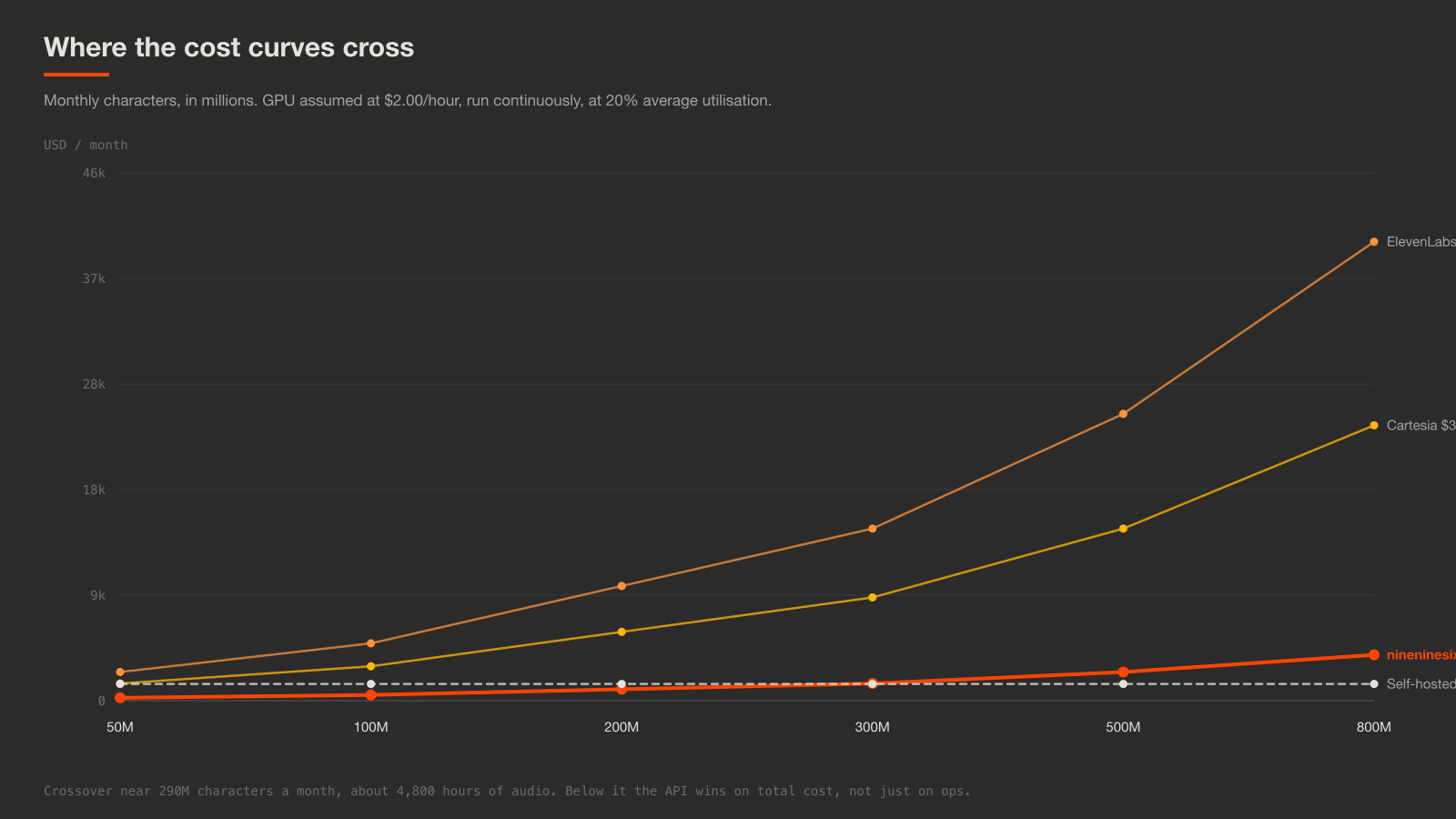
The arithmetic, so you can substitute your own inputs:
| Input | Value |
|---|---|
| GPU rental | $2.00 / hour |
| Running continuously | 730 hours / month |
| GPU cost | $1,460 / month |
| API rate | $5 / million characters |
| Break-even volume | 292M characters / month |
Below that line the API is cheaper in raw spend, before you count any operational cost. Above it, the GPU wins and keeps winning, because its cost is flat while the API bill grows linearly.
The crossover moves sharply with the API rate you are comparing against. That is the part worth internalising:
| API rate | Crossover volume | Crossover in hours of audio |
|---|---|---|
| $5 / M (nineninesix) | 292M chars | ~4,870 h |
| $30 / M (Cartesia, Deepgram Aura-2) | 49M chars | ~810 h |
| $50 / M (ElevenLabs Flash) | 29M chars | ~490 h |
Against a $50 API, self-hosting pays off at 29 million characters a month, which a modestly successful voice product hits quickly. Against a $5 API you need ten times the volume before the GPU is worth the trouble. Cheap inference does not just save money, it moves the point where you have to become an infrastructure team.
Can one GPU even handle that volume?#
Comfortably, and that is why the flat line is flat.
Gepard's aggregate throughput reaches 204 times real time at 256 concurrent streams on a single server-class GPU, a figure that comes from vLLM's continuous batching and PagedAttention doing the heavy lifting, with 64 to 128 streams the recommended range for live traffic. At 102x real time, a GPU running flat out produces about 102 hours of audio per wall-clock hour, which is roughly 6.1 million characters an hour.
At 100% utilisation that is 4.5 billion characters a month, so capacity is not the constraint. Utilisation is.
What does utilisation do to the number?#
It is the variable most estimates quietly assume away, and it is usually the one that decides the answer.
A GPU bills for every hour it is powered on, not for the audio it produced. Voice traffic is rarely flat: it peaks in business hours, collapses overnight, and differs by weekday. A workload that looks like 8 busy hours on weekdays averages under 20% utilisation across the month.
| Average utilisation | Effective cost per 1M characters |
|---|---|
| 100% | $0.33 |
| 50% | $0.65 |
| 20% | $1.63 |
| 10% | $3.27 |
| 5% | $6.53 |
At 5% average utilisation, a self-hosted GPU costs more per character than our API does. You have taken on a GPU, a deployment and an on-call rotation to spend more money.
Autoscaling helps and does not eliminate the problem, because model load time means you cannot scale to zero between calls without paying a cold start on the next one.
What does self-hosting cost that is not the GPU?#
The line items that never make it into a comparison table, and routinely exceed it for a small team.
Someone on call. A voice agent that stops speaking is an outage. That is a rota, not a task.
Upgrades. Model versions, vLLM releases, CUDA drivers, the host OS. Each is a scheduled risk against a live service.
Autoscaling and cold starts. Loading weights takes time. Handling a traffic spike without dropping calls means either paying for idle headroom or accepting a cold start on the edge of a peak.
Monitoring. Not just uptime. Time to first audio drifting from 50 ms to 200 ms is an outage your users feel and your dashboard may not show.
Capacity headroom. Sizing for the median means failing at the peak, so you buy for the peak and pay for it constantly.
Multi-region. Latency is geography. One GPU in one region gives users on another continent a worse experience than an API with edge presence.
Note
A defensible rule of thumb: if self-hosting does not save at least 3x on raw spend, it is not saving anything. The difference goes into work you were not doing before.
So which should you pick?#
Use the API when you are below the crossover, your traffic is spiky, you have nobody to own a GPU, you need multi-region latency, or you are still changing the product weekly. This covers most teams for longer than they expect.
Self-host when you are meaningfully past the crossover with steady traffic, your audio cannot leave your infrastructure, you need the network round trip gone, or you need a version pinned for longer than any vendor will support it.
Run both when you have a steady base load and spiky peaks. Self-host the base, burst to the API. This only works if both sides run the same model, which brings us to the part that is not about money.
The thing that decides this more than cost#
Whether you can change your mind later.
With a closed vendor, "self-host" is not a slower option, it is not an option. Crossing the volume threshold, or winning a customer with an air-gap requirement, means a migration to a different model with different voices and different output. Every prompt retuned, every voice re-chosen, every regression re-found.
With Apache 2.0 weights, the same model runs in both places. Start on the API because it ships fastest. Move to your own GPUs when the arithmetic says so. Deploy on-premise when a customer requires it. Same weights, same voices, same wire protocol.
That is the argument for open weights that survives contact with a spreadsheet, and it is worth understanding before you commit either way. If you are still comparing rates, ten vendors on one axis is the place to start.
Every figure here is arithmetic you can redo with your own GPU price and your own utilisation. We would rather you ran it than took our word for which side of the line you are on.
Frequently asked questions
- At what volume does self-hosting TTS become cheaper than an API?
- Against a $5 per million character API, a GPU at roughly $2 an hour breaks even near 290 million characters a month, about 4,800 hours of audio. Against a $30 API the crossover falls to around 49 million characters. The threshold moves with your GPU price and how busy you can keep it.
- How many concurrent TTS streams can one GPU serve?
- For Gepard on a server-class GPU, the recommended operating range is 64 to 128 concurrent streams, with throughput scaling linearly to about 204 times real time at 256 streams. Live conversation should stay in the lower band, because pushing to 256 lengthens the queue each request waits in.
- What does self-hosted TTS cost besides the GPU?
- An on-call rotation, model and driver upgrades, autoscaling, cold-start handling, monitoring and capacity headroom for peaks. These are usually larger than the GPU bill for a small team, and they do not appear in any cost calculator, including this one.
- Can I move from a TTS API to self-hosting without changing my code?
- Only if the model is the same on both sides. With open weights under a permissive licence you run the identical model in both places, so voices and output stay consistent. With a closed vendor there is no self-hosted path at all, so the move is a full migration.
- Is GPU utilisation the main variable in self-hosting cost?
- Yes, and it is the one most estimates get wrong. A GPU bills for every hour it is running, not for the audio it produced. Traffic that peaks during business hours and drops overnight can easily average under 20 percent utilisation, which triples your real cost per character against a naive calculation.

Co-founder, nineninesix.ai
Co-author of the Gepard technical report. Works on real-time speech models and the infrastructure that serves them, and writes about the parts of text-to-speech that only show up in production.
Try it on your own text
Gepard is open source under Apache 2.0 and the hosted API starts free. No card, no sales call.
Keep reading
- Engineering ·
Why Gepard runs on vLLM, and what it buys
- Engineering ·
How to fine-tune Gepard (and when not to)
- Engineering ·
How text to speech works, and how to choose