How to fine-tune Gepard (and when not to)
 Nursultan Bakashov5 min read
On this page
Zero-shot cloning takes minutes and covers most cases. A LoRA fine-tune needs about 1 hour of clean audio, a full one needs 4 GPUs. Where each line falls.
Most teams that ask how to fine-tune a speech model do not need to fine-tune a speech model. They need a voice that sounds like a particular person, and there is a much cheaper way to get one.
So this guide starts with when not to, then covers how to do it properly when the cheaper path genuinely fails.
Three ways to get a custom voice#
Try them in this order. Only move down when the option above fails on your own audio.
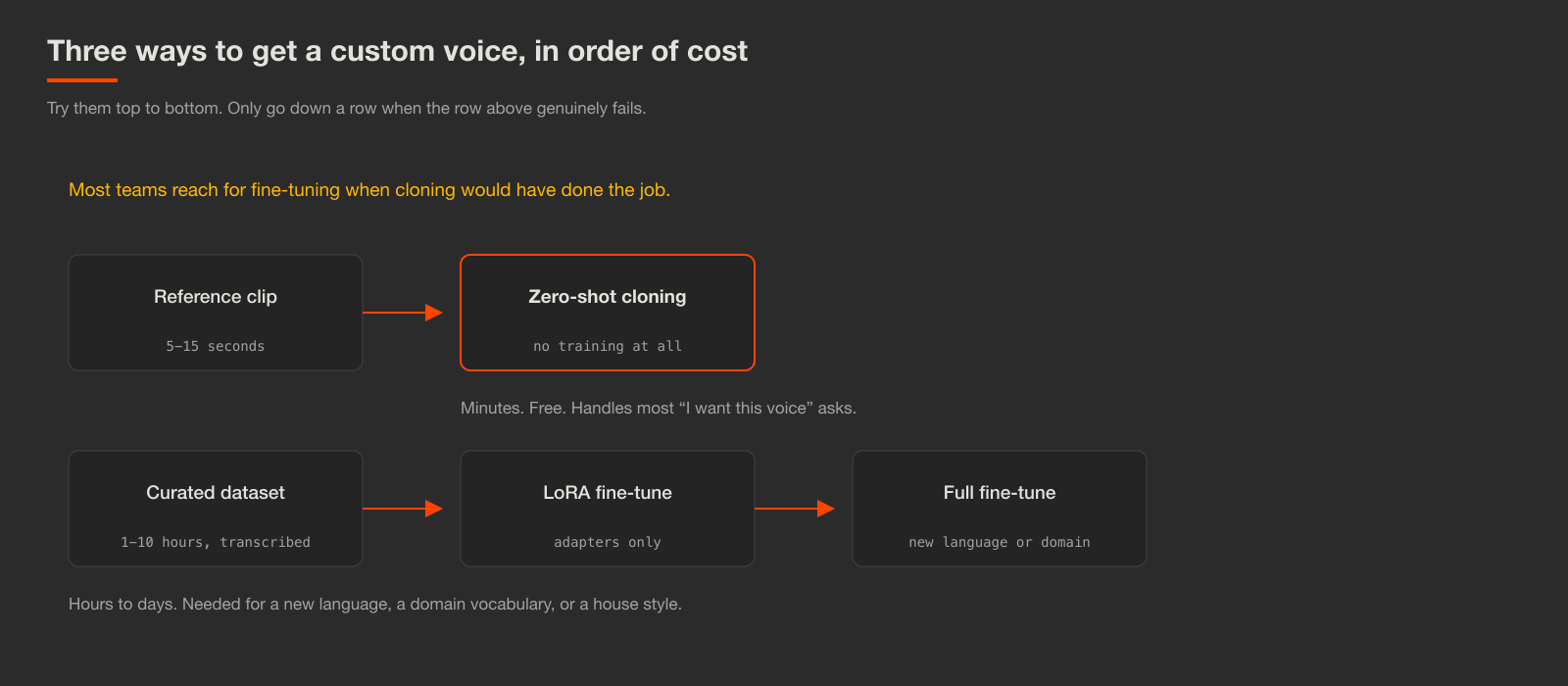
Zero-shot cloning. Five to fifteen seconds of reference audio, no training at all. In Gepard the speaker is captured once, up front, as a Q-Former prefix computed before generation starts, which is why cloning adds nothing to the per-token cost. Minutes of work, no GPU, no dataset.
LoRA fine-tune. About an hour of clean transcribed audio, a single GPU, a few hours end to end. The backbone stays frozen and you train adapters.
Full fine-tune. A curated dataset in the tens of hours, multiple GPUs, days. Reserved for a new language or a genuine domain shift.
The honest rule: if the requirement is "make it sound like this person", cloning solves it. If the requirement is "make it handle Kyrgyz" or "stop mangling our product names", cloning will not, and you are in fine-tuning territory.
When is fine-tuning actually justified?#
Four cases, in rough order of how often they come up.
A domain vocabulary the base model mangles. Drug names, part numbers, street names in one city, an industry's acronyms. The base model has never seen them and pronounces them by analogy, badly.
A language the model does not cover. Gepard ships English, Spanish (Mexico), Portuguese (Brazil) and Dutch. Anything else is a fine-tune, and a substantial one.
A register the base model handles poorly. The clearest example in our own work is the short register: one- and two-word utterances behave differently from ordinary speech in autoregressive decoders. Our technical report treats this as a fundamental issue in the model class rather than a bug, and the shipped training pipeline includes a short-phrase adaptation stage specifically for it. If your agent says "Yes." and "Got it." a hundred times an hour, this matters more than MOS.
A house style. Consistent pacing, a particular energy level, a way of handling questions. Cloning copies a voice; it does not reliably copy a delivery style across arbitrary text.
LoRA or a full fine-tune?#
LoRA, in almost every case, and the evidence has converged on this.
Published comparisons find LoRA reaching near-parity with full-parameter fine-tuning on voice similarity and naturalness, at a fraction of the memory and training time. One line of work reports that tuning around 15% of backbone parameters gets you comparable results to full fine-tuning, where earlier attempts at 0.3% to 5% left quality on the table. The LoRP-TTS work on low-rank personalised speech covers the speaker-adaptation case in more detail, and Unsloth's TTS fine-tuning guide is a practical starting point for the general workflow. Full-parameter fine-tuning on speech models is also frequently unstable, because dataset quality is uneven and the model has more room to forget.
That last point is the one that decides it. A full fine-tune on an hour of one speaker will make the model excellent at that speaker and measurably worse at everything else. LoRA leaves the base intact.
| LoRA | Full fine-tune | |
|---|---|---|
| Data needed | ~1 hour, single speaker | tens of hours |
| Hardware | 1 GPU | 4 GPUs (FSDP) |
| Time | hours | days |
| Catastrophic forgetting | avoided, backbone frozen | a real risk |
| Right for | a voice, a register, a vocabulary | a new language |
How much data, and what kind?#
About one hour of clean single-speaker audio is the working figure for a LoRA voice adaptation. But duration is the least important of the three variables.
Transcript accuracy beats quantity. Thirty minutes with exact transcripts beats three hours with approximate ones. Errors in the text teach the model the wrong mapping, and it learns them faithfully.
Recording consistency beats variety. One microphone, one room, one session. Mixed sources teach the model to reproduce the mix, including the room.
Coverage of what you will actually synthesise. If the product reads out order numbers, the dataset needs order numbers. A dataset of read prose produces a model good at read prose.
Note
Before recording anything, run your real text through the base model and listen to what fails. Half the time it is text normalisation, not the acoustic model, and a preprocessing rule fixes it in an afternoon with no training at all.
Running the training#
The pipeline is public in gepard-train, with a Hydra config tree under conf/. Four stages:
1. Dataset build. Encodes raw audio into NanoCodec tokens. The model trains on discrete audio codes, not waveforms, so this is a required preprocessing step rather than an optimisation.
make datasetThe reference corpus on Hugging Face, nineninesix/emolia_filtered_nano_codec_21_dataset, is already tokenised. Inspect it before preparing your own so you know the shape you are aiming at.
2. Pretrain. Base model training on the full corpus, four GPUs with FSDP. You almost certainly do not need this stage.
make train3. LoRA fine-tune. Short-phrase adaptation with a frozen backbone and trained adapters, single GPU. This is the stage most people want.
make finetune
make merge CHECKPOINT=checkpoints/checkpoint-N
4. DPO. Offline classifier-free-guidance distillation. Self-generated preference pairs bake the quality of two-pass CFG into single-pass weights, which is how the shipped model gets two-pass quality at one-pass cost.
make dpo-sample-sharded
make dpo-score
make dpo-pairs
make dpo-train
Publishing the result:
make upload REPO=you/your-model CHECKPOINT=<merged-dir>Because the weights are Apache 2.0, a model you fine-tune is yours to ship, sell or keep private, with no revenue ceiling and no obligation to publish it.
How do you know it worked?#
Not by listening to three clips and feeling good about them.
Hold out real text. Sentences from your actual product that were never in training. Read-prose evaluation on a voice agent model tells you almost nothing.
Measure word error rate, on your text. Transcribe the output with a separate ASR model and compare. Pay particular attention to digits, which break in ways prose does not and which no public benchmark measures.
Check what you broke. Run the base evaluation set through the fine-tuned model. LoRA makes forgetting unlikely, not impossible, and a model that got better at your voice and worse at numbers is a bad trade you want to catch before shipping.
Listen at the boundaries. Very short utterances, very long ones, unusual punctuation, all-caps, numbers next to words. Failures cluster at the edges.
Compare against cloning. Run the same text through zero-shot cloning with a reference clip. If the fine-tune is not clearly better, you spent a week for nothing, and knowing that is worth the ten minutes.
Serving what you trained#
A merged checkpoint runs on the same vLLM path as the base model, so the throughput numbers carry over and the serving setup does not change.
Whether it is worth running your own GPU to serve it is a separate arithmetic problem, and the answer depends more on utilisation than on volume.
Frequently asked questions
- How much audio do you need to fine-tune a text-to-speech model?
- For a LoRA fine-tune targeting one speaker, about one hour of clean, accurately transcribed single-speaker audio is the widely reported working figure. A new language or a broad domain shift needs far more, in the tens of hours. Quality and transcript accuracy matter more than raw duration.
- Should I use LoRA or a full fine-tune for TTS?
- LoRA, in almost every case. Published comparisons find LoRA reaching near-parity with full fine-tuning on voice similarity and naturalness while using a fraction of the memory and time, and it avoids catastrophic forgetting of the base model's general speech ability. Full fine-tuning is for a new language or a fundamental domain shift.
- Do I need to fine-tune to get a custom voice?
- Usually not. Gepard supports zero-shot voice cloning from a few seconds of reference audio, with the speaker captured once up front so cloning adds nothing to the per-word cost. Fine-tune only when cloning genuinely fails, which is typically a new language, a domain vocabulary or a house style rather than a specific voice.
- What hardware do you need to fine-tune Gepard?
- A LoRA fine-tune runs on a single CUDA GPU. Pretraining the base model uses four GPUs with FSDP. If you are adapting an existing voice or a short-phrase register, one GPU is enough.
- What dataset format does Gepard training expect?
- Audio pre-encoded to NanoCodec tokens rather than raw waveforms. The pipeline has a dataset build stage that does this encoding, and the reference dataset on Hugging Face is already tokenised so you can inspect the expected shape before preparing your own.

Co-founder, nineninesix.ai
Co-author of the Gepard technical report. Works on real-time speech models and the infrastructure that serves them, and writes about the parts of text-to-speech that only show up in production.
Try it on your own text
Gepard is open source under Apache 2.0 and the hosted API starts free. No card, no sales call.
Keep reading
- Engineering ·
Self-hosted TTS or an API: the crossover
- Engineering ·
Why Gepard runs on vLLM, and what it buys
- Engineering ·
How text to speech works, and how to choose